When you start looking for a family milk cow, it doesn’t take long to find someone who thinks their favorite breed is the only one worth owning. Jerseys have their following, Holstein owners will tell you how much milk you’re missing, and a picture of a little Dexter standing in green grass can make the whole decision look easier than it is.
I love a Jersey cow, so if you ask me where to begin looking for a family milk cow, that’s where my answer will usually start. Their smaller size and rich milk make them a good fit for the kind of home dairy I enjoy, especially when fresh cream and homemade butter are part of the plan. That doesn’t mean every Jersey is a good family cow, or that another breed couldn’t suit your household better. The best breed for a family milk cow is the one that fits your needs, and the best cow within that breed is one you can safely handle, properly feed, and comfortably milk.
I’ve milked full-sized Jerseys and a mini Jersey, and their production has been a good reminder that size doesn’t tell you everything. A smaller cow can still leave you with plenty of milk to deal with. Before you start choosing colors or comparing breed descriptions, think about what you want your cow to provide and what keeping her will require.
This article contains affiliate links. If you purchase through these links, I may earn a commission at no additional cost to you. As an Amazon Associate, I earn from qualifying purchases.
Start With the Milk Your Family Will Actually Use
There is a difference between wanting fresh milk and wanting to process several gallons every day. Drinking milk, making yogurt, and putting cream in your coffee are one thing. Regular cheesemaking, churning butter, and finding uses for the skim milk require more time and refrigerator space.
Look at what your family uses in a normal week, then consider the dairy foods you realistically expect to make. If butter is high on your list, think about cream as well as gallons. My guide to making homemade butter and cultured buttermilk explains what happens after you have the cream in your kitchen.
You also need to distinguish the cow’s total production from the milk you’ll bring into the house. If her calf is nursing, part of that milk belongs to the calf. My article on how much milk a family milk cow produces per day explains the factors that affect what ends up in your bucket.
A seller’s production number needs some context. Ask when she calved, how often she is milked, whether a calf is nursing, and what she eats. Her production will change throughout her lactation cycle, so today’s milk supply isn’t a promise about every month ahead.
Family Milk Cow Breeds Compared
This table is a starting point for your search. It describes general breed tendencies and practical buying considerations, rather than promising a particular number of gallons or a certain temperament.
| Breed | General size | Why a household might consider her | What to check before buying |
|---|---|---|---|
| Jersey | Smaller dairy breed | Rich milk and a smaller frame than the larger dairy breeds | Actual production, body condition, handling, and teat suitability |
| Guernsey | Intermediate dairy size | Rich milk with the breed’s characteristic golden tint | Local availability, production records, and milking training |
| Brown Swiss | Large dairy breed | Dairy production and milk valued for cheesemaking | Feed budget, facilities, and whether the milk volume fits your plans |
| Milking Shorthorn | Medium to large | Dairy production; some lines also suit milk-and-beef goals | Whether the line is dairy-selected or heritage dual-purpose |
| Holstein | Large dairy breed | Substantial milk production for households with uses for the surplus | Production level, reason for sale, feed requirements, and handling |
| Dexter | Small cattle breed | Milk-and-beef goals in a smaller animal | A demonstrated milking history, udder structure, and actual yield |
| Dairy cross | Depends on parentage | A suitable individual may fit household needs very well | Her own records and behavior rather than assumptions about the cross |
Breed associations and extension publications can help you understand these differences, but they can’t evaluate the cow you’re about to buy. Keep the table in mind while you shop, then give the individual animal a much closer look.
Why the Jersey Is My Favorite Family Milk Cow
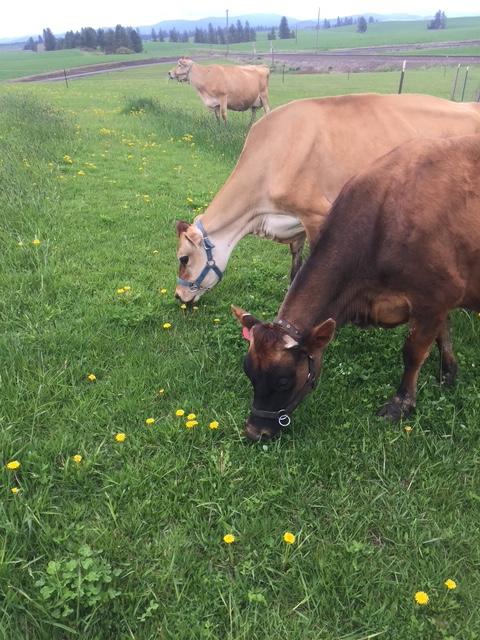
My love of Jerseys has a lot to do with what comes into the kitchen after milking. I want milk we can drink and cook with, along with cream for butter and other homemade dairy. Jerseys deserve consideration for exactly that reason, and their smaller frame is another reason I like them as family cows. The American Jersey Cattle Association reports high fat and protein levels in Jersey milk, although an individual cow’s results will vary.
I’ve milked both full-sized Jerseys and a mini Jersey, and I wouldn’t choose between them by height alone. I would want to know how much milk that particular cow gives, how she behaves during chores, and whether her feeding needs fit what I can provide. I can love the breed and still be particular about which cow comes home.
What I wouldn’t do is buy a Jersey simply because someone says Jerseys are gentle. You still need to see how she behaves around people, how she enters the milking area, and whether she stands while being milked. A cow who is friendly at the fence isn’t necessarily comfortable having someone sit beside her udder.
Pay attention to her production and feeding routine, too. A smaller frame doesn’t make a high-producing dairy cow inexpensive to feed, and it doesn’t remove the need to monitor her condition. If you’re planning to hand milk, make sure her teats are comfortable for your hands rather than assuming every Jersey will suit you.
For hand milking, I prefer a seamless stainless steel milk pail because it is durable and easier to clean thoroughly than a bucket with seams, scratches, or hard-to-reach corners.
Guernsey: Another Breed to Consider for Rich Milk
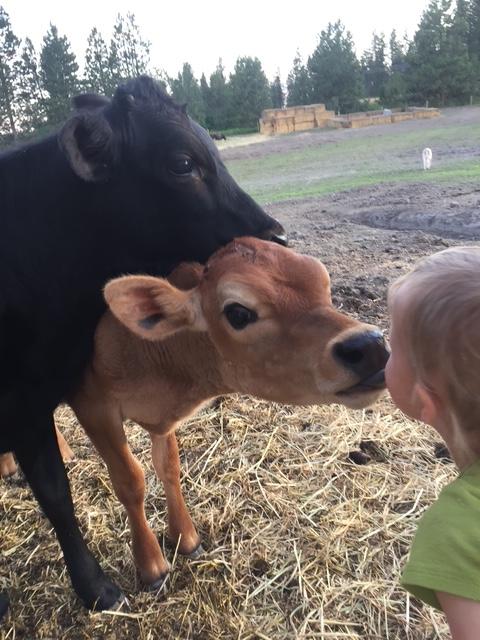
If rich milk and cream are high on your list, do not overlook the Guernsey. Their milk is known for its golden tint, associated with beta-carotene, and they offer another option for families looking beyond the highest-volume dairy breeds.
The practical question is what you can find near home. Compare a Guernsey’s records, training, and condition with the other cows available to you rather than deciding the breed is worth any price or any distance. A long trip doesn’t make an unsuitable cow a better purchase.
Brown Swiss: Consider Her Size Along With Her Milk
Brown Swiss are considerably larger than Jerseys, but their milk and steady production make them appealing to families interested in cheesemaking.
Before buying one, look honestly at your setup. Can she move comfortably through the gates and milking area? Do you have appropriate handling facilities, enough feed storage, and a plan for the milk she is currently producing?
Don’t rule out a good cow because she is large, but don’t let a reputation for calmness substitute for suitable facilities. My milking parlor and processing room tour gives you a look at our arrangement and the work that continues after milking is finished.
If making cheese is part of your plan for all that milk, my homemade mozzarella and ricotta recipe is a good place to begin, whether you bring home a Brown Swiss or another dairy breed.

Milking Shorthorn: An Option for Milk and Beef
For a homestead that wants milk for the house and calves to raise for beef, a Milking Shorthorn may do both jobs well. The breed has a history of providing both, but you’ll want to ask about the cattle the breeder is raising. Some lines are bred more heavily for dairy production, while others retain the heritage dual-purpose traits.
The Canadian Milking Shorthorn Society explains how breeding has shifted toward dairy production over time. For your homestead, that means you shouldn’t assume a Milking Shorthorn will give less milk simply because she’s described as dual-purpose.
Ask how much the cow actually produces, what she’s eating, and whether she’s accustomed to being milked. If raising beef is part of your plan, ask about the calves from that line as well. If you expect her to provide milk and raise a useful beef calf, ask for records that show she can do both.
Holstein: Make Sure You Want the Production
A Holstein can make a good family cow if you have a plan for that much milk. The extra volume may be useful if you make cheese regularly, raise bottle calves, or feed milk to pigs and poultry. That same production can also be more work than another family wants.
Holstein milk can still provide cream and butter. A lower fat percentage than Jersey milk doesn’t mean there is no cream, and the total amount of milk also affects how much fat you have available.
If you’re considering a cow leaving a commercial dairy, ask why she is being sold. Review her udder health, breeding history, treatments, feet, and handling before calling her a bargain. A low purchase price tells you very little about the cost of keeping her; work through the expenses in my Family Milk Cow Cost Calculator before committing.
Dexter: Buy a Milking Cow, Not Just a Small Cow
Dexters catch the attention of families who want a smaller cow that can provide both milk and beef. Their size may feel more manageable than a full-sized dairy cow, and the American Dexter Cattle Association recognizes both household milk and beef as traditional uses for the breed. Still, being small and capable of producing milk does not automatically make a Dexter suitable for the family milk pail.
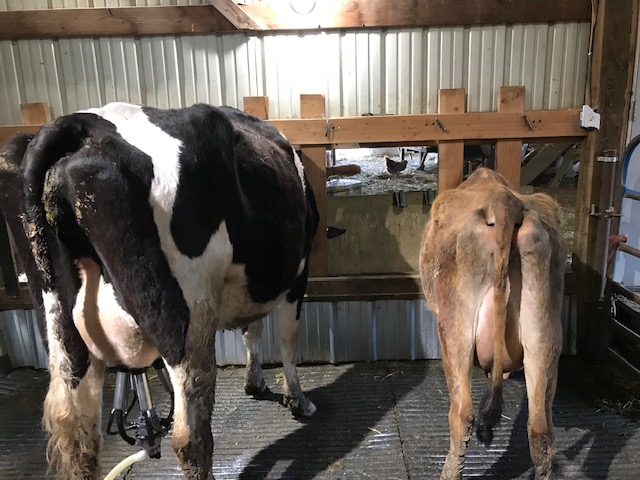
If she has only raised her own calves, she may have never learned to stand quietly while someone handles her udder. Ask to watch her being milked, find out how much she actually produces, and take a close look at her udder and teats. A Dexter may be perfectly good at raising a calf and still be a poor choice for hand milking.
Her smaller frame does not mean she can live on a patch of lawn, either. She still needs adequate pasture or purchased hay, and the amount will depend on forage quality, rainfall, and the other animals sharing the property. Read how much land a cow needs before assuming a small breed can live entirely on the grass you already have.
Do Not Overlook a Good Dairy Cross
A Jersey-Holstein cross or another dairy cross may suit your household beautifully, but parentage alone won’t tell you whether she is the right cow. Milk production, udder structure, handling, and training still need to be evaluated.
Be especially careful with promises about an unproven heifer. Her parents’ records provide useful information, but you can’t watch her produce milk before she has calved. For a beginner, an experienced cow currently being milked gives you more to assess before buying.
Depending on the breeds involved, a cross may also be less prone to milk fever than a purebred Jersey. That is not a guarantee, so I would still ask about her age, production, previous calvings, and any history of milk fever.
I share some of the lessons behind that caution in my family milk cow mistakes. There is plenty to learn after bringing home a cow without choosing one whose suitability is mostly guesswork.
Which Cow Breeds Are More Likely to Be A2A2?
If you’re shopping for a family milk cow, you’ll probably see A2A2 mentioned in sale ads, sometimes with a higher price attached. Before paying extra, make sure you understand what you’re buying. A2 refers to a form of beta-casein, one of the proteins in milk, and a cow who tests A2A2 produces the A2 form rather than A1.
Jerseys, Guernseys, Brown Swiss, and Normandes tend to carry A2 genetics more often than Holsteins, according to University of Minnesota Extension. That gives you somewhere to start looking, but it doesn’t mean every Jersey is A2A2 or that a Holstein can’t be. As much as I love my Jerseys, I would still want to see the individual cow’s test results.
A2A2 is inherited, so feeding grass or changing minerals won’t change her genetics. If this matters to your family, ask for documentation that identifies the cow you’re buying, but keep looking at everything else that makes her a suitable family cow. You still need a healthy animal with a sound udder, manageable production, and a disposition you can work with every day. I explain more in my guide to A2A2 milk and family milk cows.
What Matters More Than the Breed Label
Watch the cow through an ordinary milking before deciding. Notice how she comes in, how she is restrained, and how she responds when the person milking her touches her udder. If you plan to hand milk, ask whether she has experience with that and whether you can try under the seller’s supervision.
Look at udder attachment, teat placement, and whether all four quarters are functioning. Ask about previous mastitis and available milk-testing records. A normal-looking udder doesn’t rule out every problem, so discuss appropriate screening with your veterinarian. My article on mastitis in milk cows explains why udder-health history deserves attention.
A strip cup with a dark screen also makes it easier to examine the first streams from each quarter for flakes, clots, or watery milk.
If the seller is willing, a California Mastitis Test kit can help screen each quarter for elevated somatic cell levels. It cannot identify the organism causing a problem, but it can reveal inflammation that may not be obvious from looking at the milk.
Ask about her last calving, current breeding status, and any history of difficult deliveries. If she’s pregnant, confirm what is known about the sire and expected calving date. Having your calving supplies ready is part of preparing for the cow you actually buy.
Questions to Ask Before You Buy
Take this list with you so you don’t forget the practical questions while you’re admiring the cow:
- Can I watch a complete milking and, if appropriate, try milking her?
- How much is she producing, when did she calve, and is a calf nursing?
- What does she eat, including the amounts and types of purchased feed?
- Has she been hand milked, machine milked, or both?
- What do her health records show about mastitis, treatments, and other problems?
- Is she bred, and how has pregnancy been confirmed?
- What happened at her previous calvings?
- Why is she being sold, and what support is available after the sale?
It is easy to remember every question you meant to ask until you are standing in the barn looking at the cow. Then half of them have a way of disappearing.
Download my free Before You Buy a Family Milk Cow Checklist and take it with you when you visit a seller. It includes the health, milking, breeding, calving, feeding, and sale questions you need to ask before agreeing to bring a cow home.
Enter your email below, and I will send the printable checklist straight to your inbox.
Frequently Asked Questions
Is a Jersey the best milk cow for beginners?
A well-trained Jersey is a strong candidate, especially for someone who wants rich milk from a smaller dairy cow. In my experience, Jerseys also have far more personality than the Holsteins I have worked with. They are curious, expressive, and sometimes quite opinionated, which is part of why I enjoy them so much. However, a calm, healthy cow of another breed may still be a better first purchase than a Jersey with poor training or unresolved health problems. Choose the individual cow you can properly evaluate rather than treating the breed as a guarantee.
Which breed should I choose if I want less milk?
A Dexter with a proven milking history is worth considering, but look at the individual cow’s records rather than shopping by breed alone. Calf sharing also affects how much milk you collect, although it brings its own management requirements. My guide to calf sharing with a family milk cow explains what to consider before relying on that arrangement.
Are miniature Jerseys easier to manage?
A smaller cow may fit your facilities better, but size doesn’t guarantee easy handling or low production. I’ve milked a mini Jersey that produced about four gallons over a day, so I wouldn’t buy one expecting very little milk. Ask about her actual yield, milking training, udder structure, and calving history.
Can a Holstein provide cream for butter?
Yes. Holstein milk contains butterfat, and both milk volume and fat percentage affect the amount available. If cream is a major reason you’re buying a cow, ask for her milk-component records if available rather than judging solely by breed or the appearance of one jar of milk.
Are Jersey cows automatically A2A2?
No. Jerseys tend to carry more A2 genetics than some other breeds, but a Jersey can still have a different beta-casein genotype. You need an individual genetic test to confirm A2A2, just as you would for a Guernsey, Brown Swiss, Normande, or Holstein.
Should I buy a heifer or a cow already in milk?
For a first-time owner, I would rather see you buy a calm, experienced cow that is already in milk. You can watch her being milked, see how much she is actually producing, and get a much better idea of what you are bringing home. An uncalved heifer still comes with plenty of unknowns. Her lower purchase price may not look like much of a bargain once you add breeding, waiting for her to calve, and teaching her to stand for milking.
Practical Homesteading Help, Straight From the Farm
Choosing the Cow You’ll Want to Milk Every Day
Jerseys will always have my heart, and they’re a sensible place to start your search if you want rich milk from a smaller dairy breed. I would still keep an open mind about a good cow of another breed. The right purchase should fit your milk needs, feed budget, facilities, and ability to handle her safely.
Take time to watch her milked, understand her records, and ask the questions that matter. If you’re still sorting out the basics, my Family Milk Cow FAQ covers the broader commitment. A family cow becomes part of your daily routine, and choosing her carefully is worth more than finding the breed everyone else says you should own.