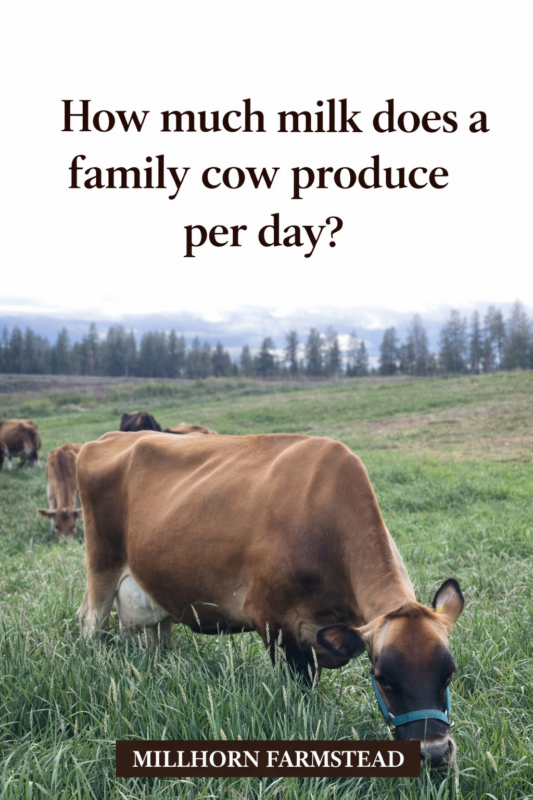
How much milk does a family milk cow produce? After years of keeping and milking our own dairy cows, I’ve learned that how much milk a cow can produce and how much milk your family actually brings into the house can be two very different things.
Most family milk cows produce somewhere between 2 and 6 gallons of milk per day, depending on breed, genetics, nutrition, stage of lactation, and how often they are milked. If you’re calf sharing, some of that milk will also be going to her calf.
For most homesteads, though, more milk isn’t necessarily better. A cow producing 1½ to 3 gallons for the house each day can provide plenty of fresh milk for drinking, butter, yogurt, cheese, and other homemade dairy without leaving you wondering what on earth you’re going to do with another five gallons of milk.
How Much Milk Does a Family Milk Cow Produce Each Day?
There is a tremendous amount of variation from one cow to another. A high-producing Holstein may give 5 gallons or more per day, while a smaller Dexter may produce closer to 1 or 2 gallons. Jerseys, one of the most popular breeds for family milk cows, often fall somewhere in between.
Breed gives you a good starting point, but it doesn’t tell the whole story. Two cows of the same breed can produce very different amounts of milk because genetics, age, feed quality, stage of lactation, and milking routine all affect what ends up in your milk pail.
Real Life Family Milk Cow Milk Production
Somewhere between Pinterest expectations and commercial dairy production numbers is real life. And real life looks a little different when you’re standing in rubber boots with a milk bucket in your hand.
I’ve milked full-sized Jerseys that gave around 2 gallons per milking and a mini-Jersey that produced about 4 gallons over the course of a day. That’s why I never recommend choosing a family milk cow based on breed averages alone.
Production on paper and production on a homestead are rarely the same thing.
Breed certainly matters, but so do the individual cow’s genetics, feed, stage of lactation, milking schedule, weather, and whether you’re sharing milk with a calf.
Those factors can mean the difference between bringing a manageable gallon or two into the kitchen each day and staring at a refrigerator full of milk wondering how much mozzarella one family can reasonably eat.
What Affects Milk Production?
Several factors have the biggest influence on how much milk your family cow produces:
- Breed and genetics
- Feed quality and consistency
- Stage of lactation
- Milking frequency
- Calf sharing
- Season and weather
Let’s look at each one and how much of a difference it can make.
Here’s a quick comparison of common family milk cow breeds:
| Breed | Typical Daily Production | Butterfat | Best For |
|---|---|---|---|
| Jersey | 2–4 gal/day | High | Cream, butter, cheese |
| Guernsey | 2–4 gal/day | High | Rich household milk |
| Brown Swiss | 3–5+ gal/day | Moderate-high | Larger families, cheesemaking |
| Holstein | 4–6+ gal/day | Lower | High-volume households |
| Ayrshire | 3–5 gal/day | Moderate | Balanced household production |
| Dexter | 1–2 gal/day | High | Smaller homesteads |
| Dairy Cross | Varies | Varies | Often excellent family cows |
*
What Affects How Much Milk a Cow Produces?
Milk production isn’t a fixed number. Even the same cow can give very different amounts of milk throughout the year. Genetics, nutrition, stage of lactation, milking frequency, calf sharing, and even the weather can all change what ends up in your milk bucket.
Genetics
Breed gives you a general idea of what to expect, but genetics tell you much more about the individual cow. Some family lines have been selected for generations to produce large quantities of milk, while others naturally produce less.
If you’re buying a family milk cow, ask about her previous lactations whenever possible. If she’s a first-calf heifer, ask about the production of her dam and other cows in the same family line.
Milking Frequency
How often you milk also affects production. Twice-a-day milking generally encourages greater production because the udder is being emptied more frequently.
Many family-cow owners eventually choose once-a-day milking because it fits their homestead better. You may sacrifice some production, but for a household already bringing several gallons of milk into the kitchen each week, that can be a perfectly reasonable trade-off.
Season and Weather
Milk production can also change with the seasons. Extreme heat can reduce feed intake and milk production, while cold weather increases a cow’s energy requirements.
Pasture quality changes throughout the growing season as well, which can affect both how much milk your cow produces and the richness of that milk.
The important thing is to watch your individual cow rather than obsess over a number on a breed chart. Her body condition, appetite, manure, milk production, and overall health will tell you far more than an “ideal” number ever will.
Stage of Lactation
A cow doesn’t produce the same amount of milk from freshening to dry-off. Production generally climbs after calving, reaches a peak, and then gradually decreases as her lactation progresses.
This is normal. A cow giving several gallons a day early in lactation may be producing considerably less by the time you’re preparing to dry her off.
Feed and Nutrition
Milk doesn’t come from nowhere. A cow needs enough quality forage, energy, protein, minerals, and clean water to support milk production.
Poor-quality hay, inadequate pasture, nutritional and mineral deficiencies, or simply not eating enough can cause production to fall. At the same time, trying to push a family cow for maximum production isn’t necessarily the goal. I would rather have a healthy cow producing a manageable amount of milk than chase commercial-dairy production numbers.
Calf Sharing
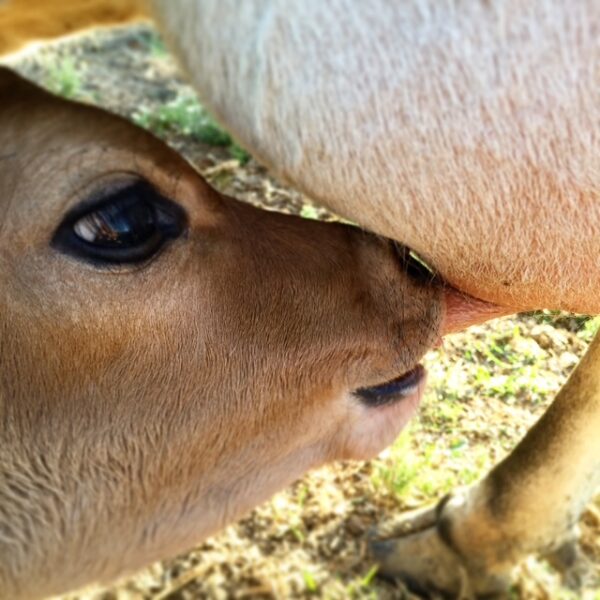
If you’re calf sharing, remember that the amount you bring into the house isn’t your cow’s total daily production.
Her calf may be drinking a significant portion of her milk. That’s one reason two families with similar cows can report very different amounts in their milk buckets.
On a homestead, consistency often matters more than maximum production.
How Much Milk Does a Family Actually Need?
Before choosing a cow based on how much milk she can produce, think about how much milk your family can realistically use.
Even what sounds like modest daily production adds up quickly:
- 1 gallon per day = 7 gallons per week
- 2 gallons per day = 14 gallons per week
- 3 gallons per day = 21 gallons per week
- 4 gallons per day = 28 gallons per week
If your family primarily drinks fresh milk and uses a little cream, a lower-producing cow may provide more than enough.
If you’re regularly making butter, yogurt, kefir, cottage cheese, or hard cheeses, you’ll use considerably more. Extra milk can also become valuable feed for pigs, chickens, or other livestock.
This is something that’s easy to underestimate before owning your first milk cow. A gallon of milk doesn’t sound like much. Seven gallons sitting in your refrigerator at the end of the week is another story.
And trust me, pouring beautiful fresh milk down the drain will make you question your life choices real quick.
How Much Milk Does a Family Milk Cow Produce on a Homestead?
This is the question people should ask first.
Because “how much she gives” matters less than “how much you can use.”
Here’s a rough idea:
- Drinking milk only → lower need
- Milk + cream → moderate
- Butter, yogurt, cheese, kefir → higher
- Feeding pigs, chickens, or dogs → much higher
A single cow can easily produce more than a small family needs unless you have a plan for the extra.
And trust me…
pouring milk down the drain will make you question your life choices real quick.
Is One Cow Too Much for One Family?
Sometimes, yes.
A high-producing dairy cow can easily produce more milk than one household can reasonably use, especially during peak lactation. That’s one reason I don’t think maximum production should be the goal when choosing a family milk cow.
The goal isn’t maximum milk. It’s the right amount of milk for your family.
For many homesteads, bringing 1 to 3 gallons into the house each day provides plenty of milk for drinking and making other dairy products.
Calf sharing can make a higher-producing cow much easier to manage because the calf helps consume the excess. Once-a-day milking may also fit some family-cow setups better than chasing maximum production with a twice-daily schedule.
Before buying a cow, think beyond how many gallons she can give. Think about what you’re going to do with that milk seven days a week.
A cow that fits your family’s kitchen, schedule, and homestead will serve you far better than one chosen simply because she can fill the biggest milk bucket.
How Calf Sharing Affects How Much Milk You Get
Calf sharing can be one of the easiest ways to manage a cow that produces more milk than your family needs.
Instead of taking all of her milk for the house, you allow the calf to nurse and take a portion of her daily production. Depending on your routine, you may separate the calf from the cow for part of the day or overnight, milk the cow, and then return the calf to her.
This can give you the best of both worlds: fresh milk for your family without having to process several gallons every single day.
Just remember that the amount in your milk bucket isn’t necessarily your cow’s total production. If you milk a gallon in the morning after her calf has been nursing, she may actually be producing considerably more than that over a full day.
For many homesteads, calf sharing is what makes keeping a higher-producing family milk cow manageable long-term.
Once-a-Day vs. Twice-a-Day Milking
How often you milk your cow can also affect how much milk she produces.
Twice-a-day milking generally encourages higher production because the udder is emptied more frequently. It’s a good fit when you need more milk or are trying to maintain greater production.
Once-a-day milking usually means accepting somewhat less milk in exchange for a much simpler daily routine.
For many families, that’s a trade worth making.
If you’re already bringing enough milk into the house for drinking, butter, yogurt, and cheesemaking, maximizing every gallon may not be necessary. A milking routine that you can maintain consistently is far more valuable than one that takes over your life.
If a simpler schedule sounds like a better fit for your homestead, read [Milking a Family Milk Cow Once a Day] for a closer look at how we manage it.
How to Choose the Right Cow for Your Homestead
Before choosing a cow based on gallons per day, think about what you actually want your family milk cow to provide.
Ask yourself:
- How many people will be using the milk?
- Do we primarily want fresh milk, or will we regularly make butter, yogurt, and cheese?
- How much milk can we realistically process each week?
- Are we willing to milk twice a day, or do we eventually want a once-a-day routine?
- Will we calf share?
- Do we have pigs, chickens, or other livestock that can use extra milk?
- Do we have enough refrigerator and storage space during peak production?
- How much time do we realistically want dairy chores to take each day?
Then, when you’re looking at an individual cow, ask about more than her breed.
Find out how much she produced during previous lactations, how often she was milked, whether she was calf sharing, and what she was being fed. If you’re considering a first-calf heifer, ask about her dam’s production and the dairy genetics behind her.
Those details will tell you far more than simply knowing she’s a Jersey, Holstein, or Dexter.
Final Thoughts
The best family milk cow isn’t necessarily the one that gives the most milk. It’s the cow whose production fits your family and your homestead.
Too little milk can be frustrating, but too much quickly becomes another chore to manage. Somewhere between the two is a cow that gives you enough fresh milk for the kitchen, enough cream for the butter churn, and enough left over for the things you enjoy making without taking over your life.
That’s the sweet spot of a good family milk cow.
Join the Homestead Kitchen & Barn
Practical dairy cow guidance, real-life homesteading, and from-scratch kitchen wisdom, straight from our farm.
FAQ
-
Best Breed for a Family Milk Cow: Choosing the Right Cow for Your Homestead
When you start looking for a family milk cow, it doesn’t take long to find someone who thinks…