
Published July 4, 2014. Updated March 2026
Homemade Livestock Fly Spray
Have you ever read the back of a livestock fly spray bottle? It’s enough to make you think twice. I don’t want those kinds of chemicals in my barn, let alone on cows that are producing food for my family.
At the same time, flies aren’t something you can just ignore. If you’ve ever tried milking with flies crawling all over your cow (and you), you know it’s not an option.
This post may contain affiliate links. If you choose to purchase through them, I may earn a small commission at no additional cost to you. I only share products we personally use and trust on our farm.
So I started looking for a more natural alternative, something that would actually help control flies without bringing harsh chemicals into our daily routine.
Essential oils have become our go-to for a homemade livestock fly spray. This is my second summer using them, and overall, I’ve been really happy with the results. I do have to apply it more often, but I’m more than willing to make that trade.
For us, it’s worth it to have a solution that feels safe to use around our cows, calves, and kids.
Related Resource
Healthy cows start with more than fly control. Mineral imbalances can affect coat condition, immune function, reproduction, and overall health, making it difficult for cattle to thrive even when external pests are managed.
Read: Dairy Cow Mineral Deficiency Guide
But before you mix this up, it helps to understand how natural fly control actually works, because it’s a little different than what you’ll find in store-bought sprays.
If you’re building a simple livestock system, start here → Start Here
Why I stopped using store-bought fly sprays
“Maybe harmful if swallowed, inhaled or absorbed through the skin. Avoid inhaling vapors or spray mist. Avoid contact with skin eyes and clothing. Wash thoroughly with soap and water after handling and before drinking, chewing gum or tobacco. Remove contaminated clothing. Wash all clothing before reuse. Foods or food processing equipment should be removed or covered during treatment. Do not apply while food processing is underway. All food processing services should be thoroughly cleaned before using. Do not apply over uncovered milk or food products. Any exposed utensils or food handling surfaces should be thoroughly cleaned before use. Facilities and equipment and federally inspected meat and poultry plants must be washed with effective cleaning compound followed by a potable water rinse after spraying. Vacate premises after treatment.”
“If swallowed call the poison control center or doctor immediately for treatment advice.
If inhaled, move person to fresh air. If person is not breathing, call 911 or an ambulance and give artificial respiration preferably mouth-to-mouth if possible.”
That was enough for me.
I wanted something I felt comfortable using daily, especially on animals we rely on for food.
That’s where this homemade fly spray comes in.
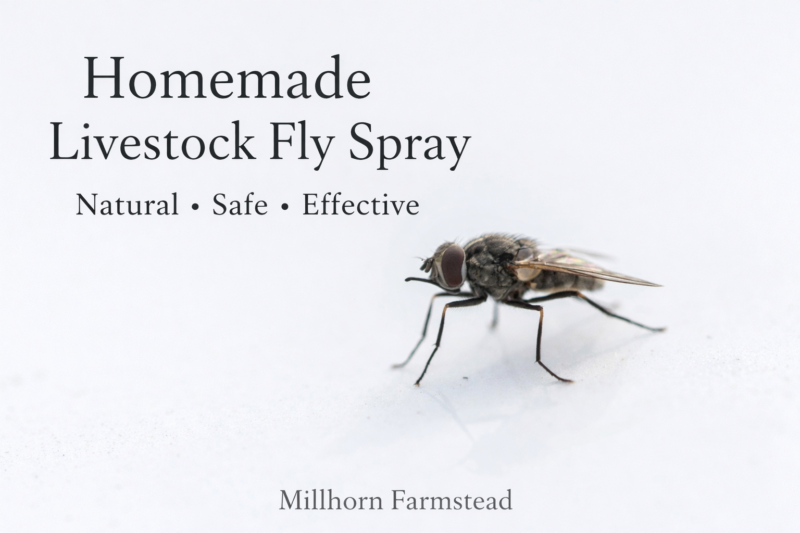
Homemade fly sprays can absolutely help but they work differently than chemical sprays.
- They repel flies, not kill them
- They break down quickly in sun and air
- And most need to be reapplied regularly throughout the day
Research has shown that essential oils like peppermint, lemongrass, and geranium can repel flies effectively, but often for only a few hours at a time
That doesn’t make them ineffective, it just means they’re part of a bigger system.
On our farm, we use this spray alongside good manure management, airflow, and timing. If you’re managing multiple animals through the heat of summer, you might also find this helpful → Raising Pigs in the Winter
Homemade Fly Spray. Safe for you, your family and your livestock.
This blend uses a combination of time-tested essential oils known for deterring flies, mosquitoes, and other pests, along with glycerin to help the scent last a little longer on the animal.
Ingredients
- 2 cups water
- 1 cup apple cider vinegar
- 1 tablespoon food-grade glycerin
Essential oils:
- 20 drops citronella
- 15 drops peppermint
- 10 drops clove
- 10 drops rosemary
Instructions
- Add water and apple cider vinegar to a spray bottle
- Stir in glycerin (this helps bind the oils and slows evaporation)
- Add essential oils
- Shake well before each use
How to Use
- Spray lightly on animals, avoiding eyes, nose, and open wounds
- Focus on legs, belly, and back where flies tend to gather
- Reapply as needed, especially in heat or direct sun
I spray my cows with Homemade Fly Spray before every milking. This will keep the flies at bay and save me from trying to milk a irritated cow. I double the recipe and make up a big batch using a 32ounce spray bottle. During the heavy summer months, this will typically last me for 2 weeks. Which isn’t bad, considering I have 6 cows that I’m spraying.

Short on time?
If you don’t have everything on hand, a simple mix of:
- vinegar
- water
- a few drops of essential oil
will still help deter flies in a pinch.
Why these ingredients work
Citronella – Well known for its anti-mosquitos properties, citronella also works incredible well for other flying pests.
Peppermint – Works as natural pest deterrent not only for flies, mosquitos but also for mice and spiders. It is also a heavy hitter in the garden and also works as a natural insecticide for squash bugs, aphids, beetles, ants, flies and fleas.
Clove – Do you remember grandma’s old trick of putting cloves into a apple and setting it on the picnic table to keep the flies and mosquitos away from the food? That “old” trick still works because the smell of clove is highly hated by flies. Clove oil is great for more then just flies, its also an excellent immune booster and a key component in the highly sought after Thieves oil. It was used in the 15th century by the original “four Thieves” to boost the immune system and keep the plague away.
Rosemary – Rosemary is a time honored herb, praised for its antioxidant properties and applied topically it’s said to treat muscle aches, improve circulation and arthritis. This potent herb is also an excellent resource for pest control not only in the barn but in the garden, working to deter cabbage loving larvae, like caterpillars.
Glycerin – Glycerin is simple a “host” or a emulsifier for the oils. I use food grade glycerin from Azure Standard, but you can also get it from Amazon HERE. Considering I also use this in homemade cosmetic’s and as a key component to teat wash its a excellent essential to have for the DIYer.
The price to make up a 16oz batch comes out to $5.80. That is an incredible price for natural, chemical free fly spray. Considering the toxic store brand cost twice that!
Optional adjustments
- For heavier fly pressure: increase citronella + peppermint slightly
- For sensitive animals: dilute with additional water
- For garden use: skip glycerin and spray directly on plants (test first)
On our farm, this is what we’ve found:
- Works best right before milking or handling animals
- Most helpful in barns, pens, and close quarters
- Less effective out on open pasture without reapplication
This isn’t a “spray once and forget it” solution
It’s something we use throughout the day, as needed
The real secret to controlling flies
Spray helps, but it’s only one piece.
What actually makes the biggest difference:
- Manure management
- Dry bedding
- Air movement
- Timing your application
- Proper Mineral Management
Natural fly control works best when everything works together.
Common mistakes with homemade fly spray
- Expecting it to last all day
- Not shaking before use
- Using too little when flies are heavy
- Relying on spray alone instead of full fly control
If you’re building a low-chemical homestead…
You might also find these helpful:


Great recipe for fly spray! Milking can be an awful experience without some kind of repellent so this is really useful. Thanks for sharing.
Wonderful recipie. Is there anything i can substitute with the pepermint since we have a sensitivity and allergy to it in our home?
I would sub with a strong herb or clove.
Peppermint has always been my go-to for natural pest control but it may be time to try a few of these others out. Rosemary seems like it would be fun to try.
I love how simple this spray is to make. It has such a few ingredients in it and sounds more like a skin treatment than a repellent. Recently Ive tried being more conscious of the products I use, it is often scary to read about what comes into our homes that’s labelled “safe”.
I have tried citronella essential. So far it is the best repellent against gnats. Saves me from those bitting gnats when walking in the woods
Does this work for ticks also? My horse gets really sick with a high fever if he is bitten. I am always looking for something that will keep him healthy. Thanks
Have you tried this spray with chickens? We are having a very bad fly year and the protected run is the worst!
Yes i have. It does great with chickens, they just aren’t very enthused about being sprayed however. You could try fresh herbs or fly predators as well.
Thanks for sharing this. luckily I have every ingredients in my kitchen. I might gonna try this at home and see for myself how effective it is. thanks again!
Makes sense that acv wouldn’t work… that’s what I put in a bowl with a drop of soap to attract gnats in my kitchen…
I like this recipe that I use on my horse it is:
1 part mint extract
4 parts water