Finding clumps in the milk bucket has a way of rearranging your morning. Whatever you planned to do after chores will probably have to wait.
Mastitis in milk cows is inflammation of the udder, most often caused by an infection. It may show up as flakes or clumps in the milk, a hot or painful quarter, or a cow who suddenly feels miserable. It can also develop without anything visibly wrong in the bucket.
During my years keeping family milk cows and operating our raw dairy, I dealt with mastitis more than once. The photographs throughout this article are from those real cases, including abnormal milk before treatment and one cow who was left with permanent udder damage afterward.
When you only have one family milk cow, mastitis can temporarily take away your entire household milk supply. More importantly, some cases can make a cow seriously ill. Knowing what you’re looking at, what you can handle at home, and when things have become serious is part of keeping a family cow.
If you are still learning the daily responsibilities, my Family Milk Cow FAQ covers the broader questions. Here, we are getting specific about the udder.
This post contains affiliate links. As an Amazon Associate, I earn from qualifying purchases at no additional cost to you.
What Mastitis Actually Means
A cow’s udder is divided into four separate quarters, each with its own teat. That is why one quarter can have mastitis while the other three look and milk completely normally.
Most mastitis starts when bacteria enter through the teat canal. Those bacteria can come from manure, wet bedding, mud, dirty hands or milking equipment. Even with one cow and a clean barn, there are plenty of opportunities for bacteria to get where they shouldn’t.
This is why I pay attention to individual quarters, not just what the milk looks like once everything is combined in the bucket.
Clinical vs Sub-clinical Mastitis
Clinical mastitis means there are visible changes in the milk or udder. Subclinical mastitis means the problem is not apparent just by looking; milk testing helps find it. Severe mastitis is clinical mastitis that also makes the cow systemically ill.
| What you notice | What I would do on a small dairy |
|---|---|
| A few flakes or small clumps, cow feels good, udder feels normal | Separate her milk, check each quarter, take her temperature, and watch her closely. Use a CMT if you have one. If you can collect a clean sample for culture, do it before treating. |
| Repeated clumps, stringy milk, watery milk, or obvious changes from one quarter | Treat it as mastitis, keep her milk out of the household supply, and start keeping notes on the affected quarter. A culture is especially useful if the problem persists or returns. |
| Quarter is hot, hard, swollen, or painful | Pay closer attention. Check temperature, appetite, hydration, manure, and how she is acting. This is more than an odd-looking milk filter. |
| Blood or significant red/pink discoloration in the milk | Stop using the milk and examine the cow carefully. Mastitis is one possibility, but injury and freshening can also cause bloody milk. |
| Possible toxic mastitis: cow suddenly looks very sick, goes off feed, becomes weak or dehydrated, has diarrhea, cold ears or extremities, or struggles to stand | This is an emergency. Call the vet. Toxic mastitis can make a cow dangerously sick very quickly. At this point, treating the udder is only part of the problem. She may need aggressive supportive care, including fluids and other treatment for the whole-body effects of the infection. |
| Quarter becomes cold, dark, blue/purple, or changes rapidly | Emergency. Call the vet immediately. Do not wait to see what the next milking looks like. |
Warning
A quick warning before you scroll any farther: Some of the photographs below are graphic. They show real cases of mastitis from cows I have owned, or consulted on, they include bloody milk, clots, stringy material, and permanent udder damage. I included them because knowing what mastitis can actually look like is far more useful than pretending it is always a few harmless flakes in the milk bucket.
Early Signs of Mastitis in Milk Cows
The first useful question is, “What has changed for this cow?”
Look for flakes, strings, clumps, or unusually watery milk. Feel for a quarter that is newly firm, hot, swollen, or painful. Pay attention when a normally cooperative cow objects to having one teat handled.
A sudden production drop deserves a closer look, too. My guide to how much milk a family milk cow produces helps establish realistic expectations. The dairy cow lactation curve explains changes over the months after calving. Neither is a reason to dismiss an abrupt drop accompanied by abnormal milk or illness.
If you first noticed a salty flavor, see why a cow’s milk may taste salty. Do not keep taste-testing suspicious milk to decide whether the problem has passed.
Normal cream separation, foam, or changes in the cream line aren’t reliable ways to check for mastitis. If something seems off, check each quarter and the milk coming from it rather than judging the whole jar.
Check the quarters individually
Before combining milk, examine the first few streams from each teat in a strip cup. Compare the quarters by sight and gentle touch. They do not have to be perfectly symmetrical, but a change from her usual shape or feel deserves attention.
Write down which quarter is affected using the cow’s left and right, not yours as you face her. That small detail becomes useful when someone else takes over chores.
What Mastitis Can Look Like
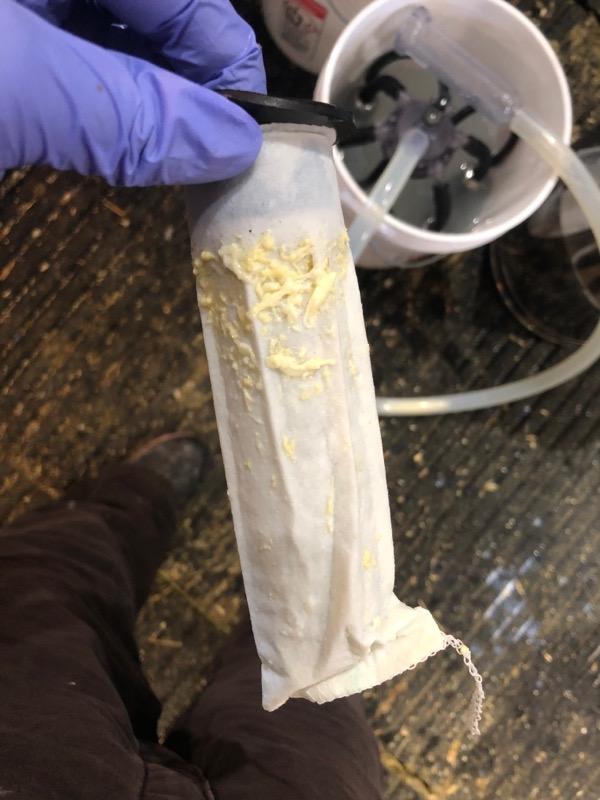
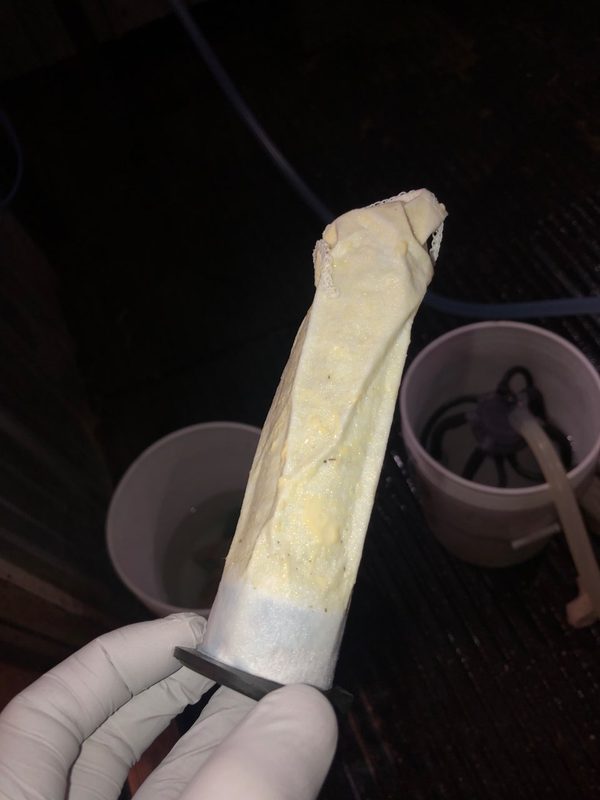
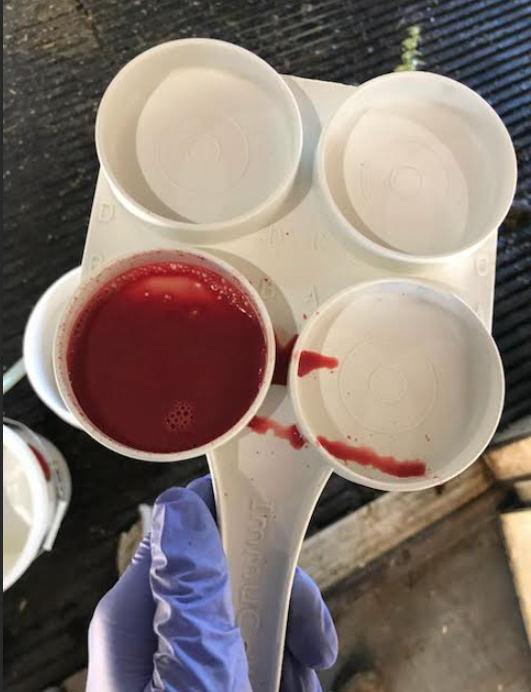
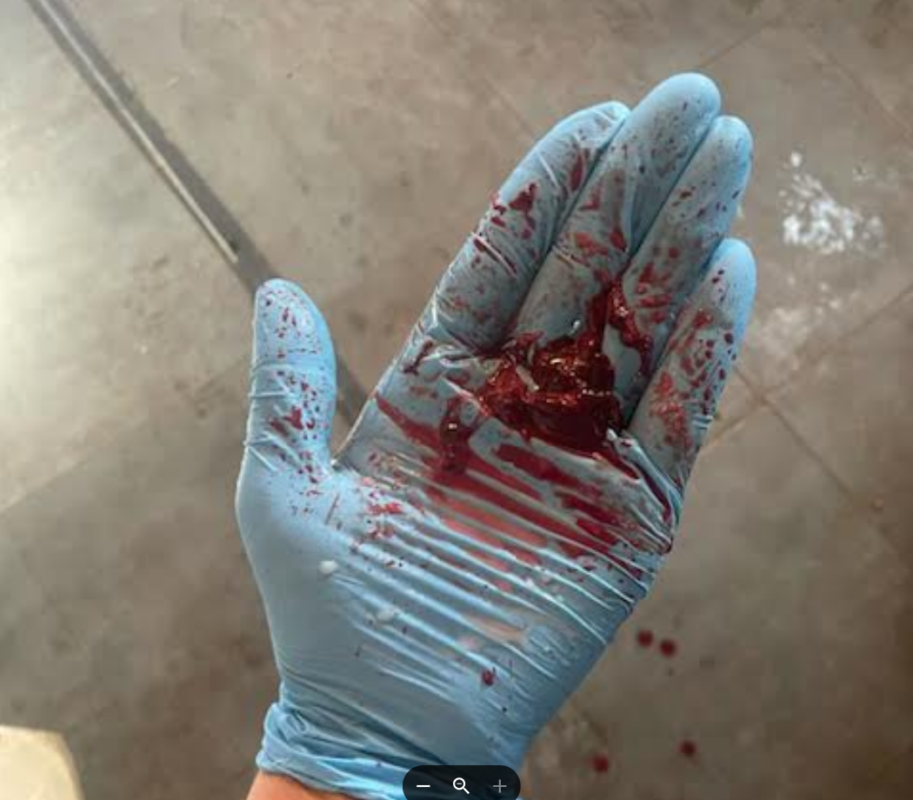
Mastitis doesn’t always look the same. These are real examples from cows I have owned, or consulted on, ranging from clumps caught in the filter to bloody milk and stringy material from the teat.
What My Mastitis Photographs Show
These photographs are useful because they show how different abnormal milk can look. They are not a chart for matching a color to a bacterium.
Clumps caught in the milk filter
Sometimes the first sign of mastitis shows up on the milk filter. These yellowish clumps were collected during milking and are an obvious sign that something isn’t right.
Don’t simply strain them out and keep the milk. Check each quarter, look at the cow, and figure out where they are coming from.
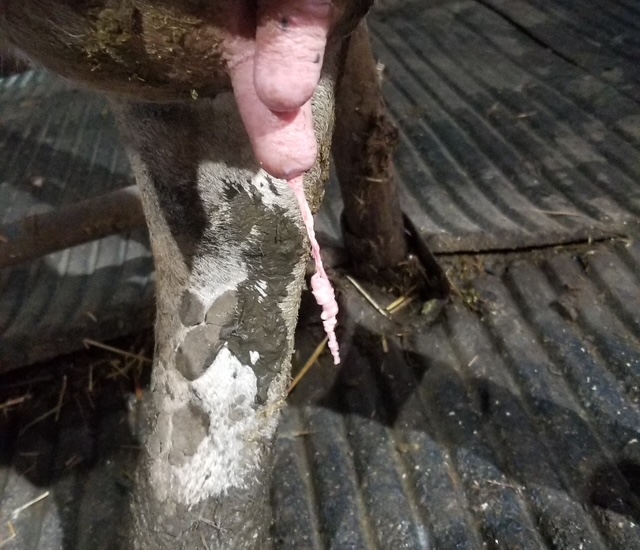
Stringy material coming from a teat
Mastitis doesn’t always look like little flakes in the milk. In this case, long, stringy pink material came directly from the teat.
Don’t pull on material like this or try to remove it by inserting anything into the teat. Check the quarter carefully and collect a clean milk sample for culture if possible.
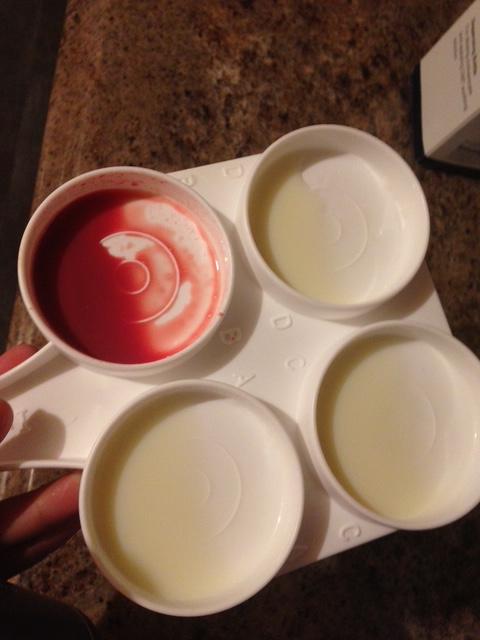
Red or pink milk
Blood in the milk can be alarming, and mastitis is one possible cause. Injury to the udder or teat and changes around freshening can also cause bloody milk.
This is another situation where the rest of the picture matters. Look at the quarter, the cow’s overall condition, and what has been happening recently rather than trying to diagnose the cause from color alone. In this case, the bleeding was caused by an overly aggressive nursing calf.
Using the California Mastitis Test
The CMT is a practical, cow-side screening test that indirectly estimates somatic cell levels by the degree of thickening or gel formation in milk from each quarter.
If you own a family milk cow, you must purchase a CMT. I personally use the MAS-D-TEC Electronic Mastitis Detector as a quick, cow-side way to check for changes in milk conductivity that can point to a problem before it becomes obvious.
Follow the directions that come with your CMT kit. Squirt milk from each quarter into its corresponding well, add the reagent, and gently swirl the paddle. Read it right away. What you are looking for is a change in consistency. Milk that begins to thicken or form a gel indicates an increasing somatic cell level. Don’t judge the test by color alone. Purple milk does not automatically mean you have a positive result.
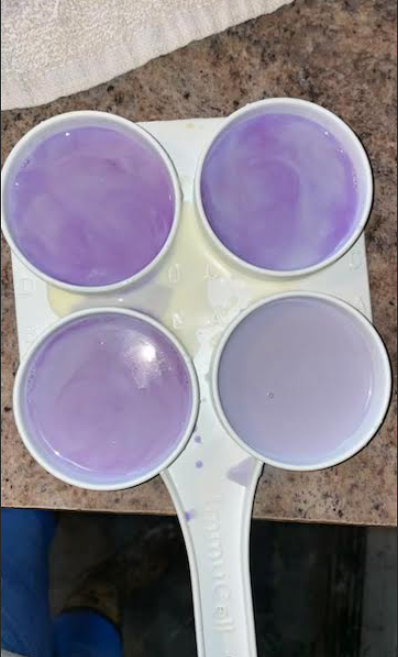
Penn State Extension demonstrates how to perform and read a CMT. You large animal veterinarian could also show you, especially if you have never watched the reaction develop in real time. Once you learn, its fairly simple.
CMT does not tell you which bacteria are present, which medication to use, whether drug residues remain, or whether raw milk is safe to drink. Keep those questions separate.
Record results by quarter and date. A pattern is more useful than remembering that the paddle “looked a little funny” sometime last week. Stage of lactation and recent inflammation can affect interpretation, so a result after calving or treatment deserves context from your veterinarian. One paddle reading is not a complete diagnosis.
Why a Milk Culture Is Worth Discussing Early
A culture looks for organisms in the sample. Your veterinarian can use that information alongside the examination and treatment history. Ask what the lab’s test includes: a standard culture does not automatically include every possible pathogen or an antibiotic susceptibility panel.
Culture is particularly useful when a quarter keeps flaring up, several cows develop problems, or the first treatment has not worked. Collect before treatment when possible, but never delay urgent care to get the perfect sample
Why a Milk Culture Can Be Helpful
Ideally, when you suspect mastitis, you collect a clean milk sample before beginning treatment and have it cultured. A culture can help identify what is growing in the milk and give you better information for deciding what to do next.
Is every family with one milk cow going to culture every case of mastitis? Probably not. I didn’t. But there are situations where I think it becomes especially worthwhile.
If the same quarter keeps giving you trouble, mastitis comes back after treatment, several cows are having problems, or your cow simply isn’t improving the way you expected, I would seriously consider having the milk cultured.
It is also worth keeping a few sterile sample tubes on hand. Mastitis has terrible timing. You do not want to be hunting for supplies after you have already found clumps in the milk.
For the cleanest sample, wash and dry your hands, make sure the teat is clean and dry, discard the first few streams of milk, and clean the teat end well with alcohol. Let it dry, then collect milk directly into a sterile tube without touching the inside of the tube or lid. Label it with the cow’s name, quarter, and date.
Then refrigerate the sample and contact your veterinarian or lab for instructions on getting it tested.
The biggest thing to remember is that you cannot look at mastitic milk and know which bacteria caused it. Thick clumps, watery milk, blood, strings, or an ugly-looking CMT can tell you something is wrong. They cannot tell you exactly what is causing it.
And if your cow is becoming seriously ill, do not wait around for culture results. A sick cow needs attention now.
Collecting a Milk Sample
If you decide to have the milk cultured, collect the sample directly from the affected quarter before treatment whenever possible.
Keep a few sterile 50 mL screw-cap sample tubes on hand with your dairy supplies. I use UHS Laboratories here in Idaho for milk testing, and they need at least 50 mL for the sample. Clean and dry the teat, discard the first few streams of milk, then thoroughly clean the teat end with alcohol and let it dry. Collect the milk directly into the sterile tube without touching the inside of the tube or lid.
Label the tube with the cow’s name, affected quarter, date, and time, then refrigerate it. When I need to ship a sample, I keep it simple: I put the chilled sample in a sealed bag with a cold pack and ship it in an inexpensive insulated padded cooler. Check with your lab for its current shipping instructions before sending the sample.
Do not collect your culture sample from the milk bucket, filter, or CMT paddle. You want milk straight from that quarter without introducing bacteria from somewhere else.
Treating Mastitis in a Family Milk Cow
This is where owning a family milk cow gets a little less black and white.
There isn’t one treatment I can tell you to use every time you see a clump. Mastitis can be caused by different organisms, cows can respond differently, and there is a tremendous difference between finding a few flakes in the milk of a cow happily eating breakfast and finding mastitis in a cow who is flat-out sick.
Start with the cow.
Is she eating and drinking normally? Does she have a fever? Is she chewing her cud? Feel the quarter. Is it hot, hard, swollen, or painful? Look at the milk. Has it changed slightly, or does it look completely wrong? And finally, look at the cow herself. Is she standing there annoyed that you’re bothering her, or does she look like she feels terrible?
Those things help determine how quickly you need to escalate.
Mastoblast
Mastoblast has long been one of my go-to products when I catch a mild case early. It is an oral homeopathic product, not something that goes into the teat.
I want to make that distinction because mastitis products get confusing very quickly when you are standing in the barn looking for something to use.
Mastoblast is not an antibiotic, and my experience using it does not mean it will treat every cause of mastitis. If the cow is getting worse, the quarter is getting worse, or she is beginning to act sick, I am not going to keep throwing the same thing at her and hoping tomorrow looks better.
ToDAY and ToMORROW Are Not the Same Thing
These two are easy to confuse because apparently someone thought naming cow medications ToDAY and ToMORROW was helpful.
They are different products.
| Product | When it is used | Important thing to remember |
|---|---|---|
| ToDAY | Mastitis treatment for lactating dairy cows | Milk must be discarded during treatment and for 96 hours after the final treatment when used according to the current U.S. label |
| ToMORROW | Dry-cow treatment used when drying off | This is not a substitute for ToDAY in a cow you are actively milking |
I would absolutely read the current label every time you use either product rather than relying on memory. Labels and veterinary directions are where withdrawal times need to come from.
With ToDAY, that 96-hour milk withdrawal begins after the last treatment, not the first. If the final treatment is Monday evening, you do not start counting from Monday morning when you gave the first tube. ToMORROW is labeled for dry cows only. It should not be administered within 30 days of calving, and milk must be discarded for the first 72 hours after calving when used according to the current label.
And remember that withdrawal applies to the cow’s milk, not just the quarter you treated.
Supportive Care Matters Too
Don’t become so focused on the ugly milk that you forget about the cow attached to the udder.
Give her clean, dry bedding, plenty of fresh water and good feed. Keep track of whether she is eating, drinking, chewing her cud and acting like herself.
Continue milking according to the treatment instructions you are following. More is not automatically better. Repeatedly stripping a sore quarter or aggressively massaging it is not going to magically squeeze the mastitis out.
And please do not put homemade concoctions inside a teat. The teat canal is exactly where we are trying to keep bacteria from entering in the first place. Do not skip your post-milking teat dip, either. I use an iodine post-dip after every milking. The teat canal does not immediately close when you remove the milker, leaving the quarter more vulnerable to bacteria for a period after milking. This is also why I want my cows standing, eating and drinking after they leave the stanchion instead of immediately lying down in the bedding.
Udder Mint is one of my favorite supportive-care products. I use it externally after milking and have had great success with it, but it does not replace proper mastitis treatment or a good post-dip.
Hygiene Matters
Some types of mastitis are contagious, which makes good milking hygiene especially important. Bacteria can be carried from an infected quarter to another quarter or another cow on your hands, towels, milking equipment, or inflations. Wear clean gloves, use a separate towel for each cow, keep your equipment clean, and milk a cow with known or suspected mastitis last whenever possible. If only one quarter is affected, be mindful of anything that touches that teat before moving on to the others. Good hygiene will not prevent every case of mastitis, but sloppy milking practices can spread a problem through a herd surprisingly fast.
A Word About Toxic Mastitis
This is the mastitis I do not mess around with.
A cow with toxic mastitis can become very sick very quickly. She may suddenly go off feed, become weak or dehydrated, develop diarrhea, have cold ears or extremities, or struggle to stand. Sometimes the cow looks far worse than the milk initially suggests.
At that point you are no longer dealing with an udder problem you can casually watch for another milking. If her mastitis becomes dark with coffee ground looking flakes, this becomes life threatening.
Call the vet.
At that point, you are no longer dealing with an udder problem you can casually watch for another milking. Dark, brown, or coffee-ground material in the milk is an alarming change, particularly when the cow is also weak, dehydrated, off feed, or declining quickly. I would treat that combination as an emergency and call the veterinarian rather than waiting to see what the next milking looks like.
This is also why I keep coming back to the same thing throughout this article: look at the cow, not just the milk.
What Happens to the Milk?
If I suspect mastitis, that milk stays out of my kitchen.
I am not going to strain the clumps out and decide the rest looks fine. I am not making cheese with it. And if I have treated the cow with a medication that requires milk withdrawal, I follow that withdrawal period.
For a family with one or two cows, I think the simplest approach is to keep that cow’s milk completely separate until you know what you are dealing with. It is much easier than ending up with six nearly identical jars in the refrigerator and asking everyone in the house, “Which one was hers?”
A negative CMT doesn’t automatically mean everything is back to normal either. It is one piece of information.
I also would not feed obviously bloody, watery, or badly abnormal mastitic milk to a calf. If you are calf sharing, you may need to temporarily change how you manage the calf while you deal with the affected quarter.
Permanent Udder Damage After Mastitis
This is one of the photographs I especially wanted to include in this article.
The enlarged udder pictured here was photographed after mastitis. This cow was left with permanent damage to the udder tissue.
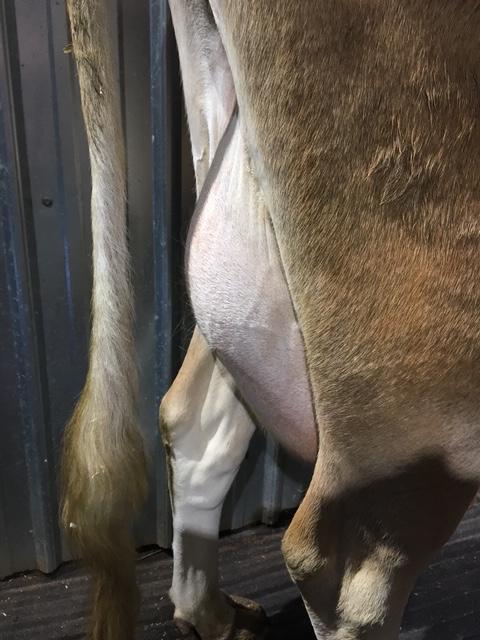
Mastitis does not always end with everything returning to normal.
A cow may recover from the infection but lose some milk production in that quarter. A badly damaged quarter may never function the way it did before. Some cows are also more likely to have trouble with that quarter again.
That is one reason I take mastitis seriously even when the cow herself seems perfectly fine.
It is also why I share photographs like this. Family milk cow ownership comes with wonderful things, but there are hard parts too. I would rather someone know what those can look like before they are standing in the barn experiencing one for the first time.
I have shared more of those lessons in my dairy animal mistakes and difficult experiences.
Preventing Mastitis on a Small Farm
Most mastitis prevention isn’t complicated. It is doing the boring things consistently.
Unfortunately, the bedding does not stay clean because you cleaned it really well last Thursday.
Keep Her Bedding Clean and Dry
Look at where your cow actually lies down.
Her udder and teats are coming into contact with that bedding every day. Wet manure, muddy lots, soggy bedding and dirty calving areas all increase the amount of bacteria around the teat end.
A barn can look perfectly respectable from the doorway while the place her udder actually rests is filthy.
Keep bedding dry, remove manure regularly, fix leaking waterers and pay particular attention to muddy areas where cows spend a lot of time.
Have a Clean Milking Routine
You do not need a commercial dairy parlor to milk cleanly.
You do need clean hands, clean and dry teats, clean towels, clean equipment and a routine you follow every time.
If you use a milking machine, pay attention to the equipment too. Worn liners, vacuum problems, overmilking and equipment that isn’t being cleaned properly can create problems of their own.
I go into the pros and cons of machine milking in Milking Machine Pros and Cons.
If you have more than one cow and one is dealing with mastitis, milk her last when you can and clean your equipment well afterward.
Pay Attention When You Change Her Milking Schedule
Any major change in milking deserves a little extra attention.
If you are moving to once-a-day milking, watch the cow rather than assuming she will adjust exactly like someone else’s cow did.
If you are calf sharing, pay attention to how often and how aggressively the calf nurses. Some calves favor certain quarters, leave others overly full, or get downright rough with the udder. An aggressive calf can cause teat and udder damage, while uneven milk removal can leave one quarter much fuller than the others.
Feel her udder. Watch production. Look at the milk. Pay attention to whether she is staying comfortable between milkings.
The same applies when life disrupts the normal routine. A power outage is a good example. If you normally machine milk, you need a plan for how that cow gets milked when the electricity doesn’t cooperate. I cover that in keeping a family milk cow during a power outage.
Don’t Forget About Drying Off
Mastitis prevention doesn’t end when you stop putting milk in the refrigerator.
Drying off is another transition that deserves some planning, particularly if the cow has a history of mastitis. If you are considering dry-cow treatment or an internal teat sealant, talk through those options before the last milking rather than trying to figure them out afterward.
And keep the calving area clean. A fresh cow is already going through enough without lying down in filthy bedding.
My family milk cow calving kit can help you get the rest of your calving supplies organized ahead of time.
Keep Records You Can Actually Use
You do not need an elaborate dairy-management program for one family cow.
You do need to write things down.
Record the cow, affected quarter, date, what the milk looked like, her temperature if you took it, CMT results, any samples you collected, what you gave her and when you gave it.
If you use a medication with a milk withdrawal, write down the exact date and time the withdrawal ends.
This becomes especially important when more than one person milks. “Don’t use her milk yet” is not particularly helpful when nobody remembers whether “yet” means tomorrow morning or next Tuesday.
Good records also become valuable when you are buying or selling a cow. Ask about previous mastitis, problem quarters and treatments rather than simply accepting, “She’s always been healthy.”
Thinking about buying a family milk cow? Before you bring one home, ask about previous mastitis, problem quarters, treatments, and her milking history. I put together a free checklist covering what I want to know before buying a cow.
To get my free checklist, click here.
And if you are new to keeping a cow, my Family Milk Cow Problem-Solver Bundle includes more than 100 pages of practical guides and printables for those first weeks, mineral concerns, off-tasting milk, daily health checks and the problems that inevitably come with keeping a family milk cow.
Frequently Asked Questions About Mastitis in Milk Cows
Can a cow have mastitis if her milk looks normal?
Yes. Subclinical mastitis can be present without visible milk or udder changes. CMT or laboratory somatic cell testing can help identify inflammation; culture can help investigate the cause.
Does bloody milk always mean mastitis?
No. Injury and changes around calving are other possibilities. Keep it out of the food supply and have the cause assessed, especially if there is pain, swelling, persistent bleeding, or illness.
Can mastitis clear without antibiotics?
Some cases can. The appropriate choice depends on severity and the organism, with veterinary guidance and monitoring. A comfortable cow with a mild case and a weak cow refusing feed need different decisions.
Will milking more often cure it?
Do not count on it. Follow the agreed milking schedule and medication instructions. Extra stripping cannot be assumed to clear an infection, and rough handling can add pain.
Can I drink milk from the other three quarters?
Do not assume it is safe. Drug-withdrawal instructions may exclude the whole cow’s milk even when one quarter was treated. Normal appearance and a negative CMT do not rule out food-safety hazards.
Does Mastoblast go into the teat?
No. The current label identifies oral administration. It is a homeopathic product, not an antibiotic udder infusion.
How long do I discard milk after ToDAY?
Under the current U.S. label, throughout treatment and for 96 hours after the final treatment. Follow your prescribing veterinarian’s instructions, and do not return still-abnormal milk to use just because the clock has run out.
Can I use ToMORROW while she is still being milked?
It is labeled for dry cows only. Do not substitute it for a lactating-cow treatment. If it was used accidentally or the cow calves earlier than expected, contact your veterinarian about residues and milk withholding.
Will her udder and milk production return to normal?
They may, but recovery is not guaranteed. Lasting tissue damage can remain after mastitis. Recheck persistent enlargement, pain, poor production, or repeated flare-ups rather than assuming the original problem is finished.
When should I call the vet instead of watching another milking?
Call immediately for whole-cow illness, weakness, refusal to eat, difficulty standing, dehydration, or a rapidly deteriorating quarter. Call promptly about new abnormal milk even when she seems comfortable so you have a plan and know when to reassess.
Pay attention to the cow you have in front of you. Keep questionable milk out of the kitchen, write down what you see, and get help when something changes. The rest of the chores can wait long enough to make a sound decision.