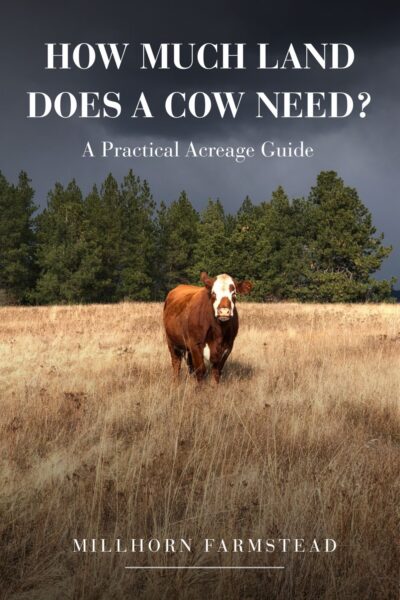
One of the first questions people ask before bringing cattle home is, how much land does a cow need?
The frustrating answer is that there isn’t one number that works for every farm.
You may hear rules like one cow per acre, two acres per cow, or even five acres per cow. Those numbers can be useful as a starting point, but they don’t tell you whether your particular piece of land can actually support cattle.
A few acres of fertile, well-managed pasture in an area with good rainfall is very different from the same number of acres in a dry climate with poor soil and a short growing season.
The better question isn’t simply how many acres you own.
It’s how much forage those acres can produce.
That is what ultimately determines how many cows your land can support.
If you’re still deciding whether a cow fits your homestead, start with my family milk cow FAQ
How Much Land Does a Cow Need?
As a general rule of thumb, you may see recommendations ranging from around 1 to 5 acres of pasture per cow or cow-calf pair. In some areas, considerably more land is necessary.
That is a huge range, which is exactly why acreage alone is a poor way to determine stocking rates.
The amount of land a cow needs depends on several factors, including:
- Pasture quality
- Soil type and soil fertility
- Annual precipitation
- Length of the growing season
- Available forage
- Cow size and body weight
- Cattle breed
- Whether you practice rotational or continuous grazing
- Whether you provide supplemental feeding
- Whether the pasture must provide winter feed
- Water availability
- Local weather conditions
A productive pasture in excellent condition can support more grazing pressure than land with thin grass, poor soil or limited rainfall.
This is also why your neighbor may successfully raise several cows on a property similar in size to yours while your land may support fewer animals.
Pasture quality matters just as much as pasture size.
Feed is also one of the largest expenses of keeping a cow, which is why I built my Family Milk Cow Cost Calculator.
How Much Land Does a Cow Need at a Glance?
The number of acres you need depends on whether you expect your land to provide most of your cow’s forage or whether you plan to purchase hay and supplemental feed. Use this table as a planning guide, not as a stocking rate recommendation.
| Situation | What the Land May Provide | What to Consider |
|---|---|---|
| 1 acre | Living and grazing space | Usually requires purchased hay and careful pasture management |
| 5 acres | Potential seasonal grazing for a small number of cattle | Pasture quality, rainfall and rotational grazing become especially important |
| 10 acres | More opportunity for seasonal grazing and multiple paddocks | Carrying capacity can vary dramatically by location and forage production |
| 20 acres | Greater flexibility for a small herd and rotational grazing | May still require winter hay or supplemental feed |
| Beef cow-calf pair | Needs enough forage for the cow and her growing calf | Cow size, calf growth, pasture quality and stocking rate affect forage demand |
| Lactating dairy cow | Requires high-quality forage to support milk production | Milk production and body weight can increase nutritional needs |
| Dry or poor pasture | Produces considerably less usable forage | More acreage or supplemental feeding may be necessary |
| Productive managed pasture | Can produce substantially more usable forage per acre | Soil fertility, rainfall, grazing management and adequate recovery are critical |
There is a huge difference between having enough land to keep a cow and having enough productive land to grow everything that cow needs to eat.
That distinction becomes especially important for small homesteads. You don’t necessarily need dozens of acres to own cattle, but less productive acreage generally means purchasing more feed.
The Difference Between Land a Cow Lives On and Land That Feeds Her
This is one of the most important distinctions for small acreage landowners.
The amount of land a cow needs to live on and the amount of land required to feed her are two very different questions.
You can keep a cow on relatively small acreage if you are willing to purchase hay and supplemental feed. In that situation, your pasture is providing exercise, some grazing and a place for the cow to live, but it may not be supplying all of her nutritional needs.
If your goal is for your farm to produce most or all of the forage your cattle consume, you need considerably more productive land.
That difference matters when you’re budgeting for cattle.
Buying another acre of land isn’t always an option. Buying hay is. But those feed costs need to be part of the decision before the cows arrive. If you’re trying to figure out what keeping a cow will actually cost on your property, use my Family Milk Cow Cost Calculator to estimate hay, feed, minerals, fencing, veterinary care and other monthly expenses.
But those feed costs need to be part of the decision before the cows arrive.
How Much Land Does a Beef Cow Need?
For beef cattle, stocking rates are commonly discussed using a cow-calf pair because you’re feeding both the mature cow and her growing calf.
Cow size matters too.
A larger cow has greater nutritional needs than a smaller cow. That means two farms with the same number of cattle may have very different forage demands depending on the size and breeds of cattle being raised.
This is where the concept of an animal unit month, often shortened to AUM, becomes useful.
An animal unit is a standardized way of estimating how much forage livestock consume. Rather than assuming every cow eats the same amount, animal units help account for differences in body weight and type of livestock.
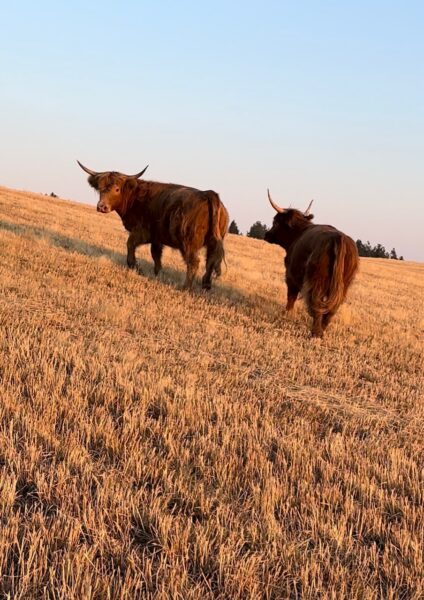
For a small homestead, you don’t need to turn grazing into a complicated math problem. You do need to understand that a 1,500-pound beef cow places more demand on a pasture than a much smaller animal.
If you’re raising cow-calf pairs, that demand increases as calves grow.
How Much Land Does a Dairy Cow Need?
Dairy cows deserve their own consideration because a lactating cow has significant nutritional requirements.
Producing milk takes energy.
A family dairy cow producing several gallons of milk each day needs enough high-quality forage to maintain her body condition while supporting milk production.
This doesn’t necessarily mean you need a huge farm to own a dairy cow.
In fact, many family milk cows are successfully kept on small homesteads where pasture is limited. The difference is that those families purchase hay and other feed rather than expecting their acreage to provide everything the cow eats.
If you’re considering a family milk cow, ask yourself two separate questions:
Do I have enough space to safely keep a cow?
And:
Do I have enough productive pasture to feed that cow?
Those aren’t the same thing.
A small acreage may provide plenty of room for a dairy cow while still requiring you to purchase hay throughout much of the year.
How much energy depends partly on how much she’s producing. A cow giving a few gallons a day has different nutritional demands than a heavy producer. If you’re trying to estimate production before buying a cow, I break that down further in How Much Milk Does a Family Milk Cow Produce Per Day?
The amount of supplemental feeding required will depend on your pasture quality, growing season, cow size and milk production.
If you’re trying to determine whether the feed bill makes sense for your family, see how much a family milk cow costs each month.
Can You Raise a Cow on One Acre?
Yes, it can be possible to keep a cow on one acre, but that doesn’t mean one acre will produce enough forage to feed her.
That distinction is important.
On very small acreage, you should expect to bring in hay and potentially other supplemental feed. You also have to manage manure, mud, pasture damage and grazing pressure carefully.
If a cow continuously grazes the same acre without adequate recovery time, she can quickly eat desirable plants faster than they can regrow.
Eventually, you don’t have a pasture.
You have a dry lot with a few stubborn weeds.
One acre can provide living space, but I would not buy a cow assuming that one acre of grass will provide all of her feed.
If you’re preparing for your first cow, my guide to the first 30 days with a family milk cow covers the feeding, milking and routine changes that catch new owners by surprise.
How Many Cows Can You Raise on 5 Acres?
Five acres gives a small acreage landowner considerably more flexibility, especially if the pasture is productive and divided into smaller paddocks.
That still doesn’t automatically mean five acres equals five cows.
On good pasture with careful management, rotational grazing can improve forage utilization and give sections of pasture time to recover between grazing periods.
Poor pasture, steep slopes, wooded areas, limited water or a dry climate can dramatically reduce the number of grazeable acres you actually have.
Five acres on paper may only provide three acres of usable pasture.
If you want to raise cattle on five acres, evaluate the available land and forage, not simply the property size.
How Many Cows Can You Raise on 10 Acres?
Ten acres can provide enough pasture for a small herd in some parts of the United States, while in other areas it may support only one or two cows without substantial supplemental feeding.
Again, local conditions make a huge difference.
Ten acres of irrigated or highly productive pasture is not equivalent to ten acres of dry rangeland.
Before deciding how many head of cattle to purchase, consider:
- How much of the property is actually grazeable
- Pasture type and grass species
- Soil fertility
- Annual rainfall
- Water availability
- Length of the growing season
- Whether you plan to rotate cattle through smaller paddocks
- Whether you will purchase hay
Starting with fewer cattle and learning how your land responds is usually much easier than beginning with a higher stocking rate and trying to repair an overgrazed pasture later.
How Many Cows Can You Raise on 20 Acres?
Twenty acres gives you more management options, but the same rules still apply.
The carrying capacity of your land determines the number of cows it can support.
If the pasture is in excellent condition, twenty acres may support a small herd during the growing season. If the soil is poor, rainfall is limited or much of the property isn’t suitable for grazing, the sustainable stocking rate may be much lower.
More acres don’t eliminate the need for pasture management.
They simply give you more pasture to manage.
Rotational Grazing Can Change How You Use Your Pasture
One of the best ways to improve pasture utilization is through rotational grazing.
Instead of allowing cattle continuous access to the entire pasture, rotational systems divide the land into smaller paddocks. Cattle graze one section and are then moved, allowing previously grazed areas time to recover.
That recovery period matters.
Grass needs enough leaf growth to continue photosynthesis and rebuild its root system. When cattle repeatedly graze new growth before the plant has recovered, pasture health eventually suffers.
Rotational grazing isn’t magic, and it doesn’t suddenly make one acre capable of feeding ten cows.
What it can do is help you use the forage you already have more efficiently while protecting long-term pasture health.
Winter Changes the Equation
A pasture that looks like it could feed an army in June may look very different in January.
This is one of the easiest things to underestimate when determining how much land a cow needs.
In areas with cold winters or a short growing season, cattle may require stored forage for several months of the year.
That forage has to come from somewhere.
You can produce hay on your own land, purchase it from another farmer, stockpile pasture for later grazing, or use a combination of those options.
If your goal is a truly self-sufficient cattle operation where your property produces both summer grazing and winter forage, you’ll generally need a larger land base than someone who plans to purchase hay.
This is also where higher stocking rates can become expensive.
More cows mean more mouths to feed when the grass stops growing.
How to Estimate Your Land’s Carrying Capacity
Instead of relying on a generic acres-per-cow number you found online, determine the carrying capacity of your land.
Start by looking at how many acres are actually available for grazing.
Remove areas occupied by the house, barn, driveway, garden and other infrastructure. Then consider wooded areas, steep slopes, wet areas or other land cattle can’t effectively graze.
Next, evaluate your pasture.
What grass types are growing?
How dense is the forage?
What is your soil type?
How much rain does your area typically receive?
How long is your growing season?
Your local Extension office or NRCS agent can be incredibly helpful here. Local recommendations are much more useful than a national rule of thumb because they account for the soil, climate and forage conditions in your area. Redmond Agriculture also has soil testing kits for smaller lots.
You can also use tools such as the Web Soil Survey to learn more about your property’s soil and potential forage production.
Most importantly, don’t stock your land to its absolute maximum the first year.
Start conservatively.
Watch how quickly your cattle graze each paddock, how well the pasture recovers and how much supplemental feeding you actually need.
Your land will tell you a lot if you give yourself time to watch it.
Frequently Asked Questions About How Much Land a Cow Needs
FAQ
So, How Much Land Does a Cow Really Need?
There is no magic number of acres per cow.
A cow might be successfully raised on a small homestead where nearly all of her hay is purchased, while another operation may require several acres per animal because the land is expected to provide most of the herd’s forage.
Beef cattle and dairy cows also place different demands on a farm, particularly when you’re feeding a lactating cow or growing calves.
Instead of asking only, “How many cows can I put on my land?”
Ask:
“How many cows can my land feed without destroying the pasture?”
That’s the number that matters.
Good cattle management isn’t about squeezing the highest possible number of animals onto a piece of property. It’s about finding a sustainable stocking rate that keeps your cows fed, your pasture healthy and your feed bill manageable year after year.
-
How to Prepare Your Homestead for a Power Outage
If the power went out tonight, would your homestead be ready for tomorrow morning? I am…
-
How Much Does a Family Milk Cow Cost? + Monthly Cost Calculator
Owning a family milk cow is one of the most rewarding investments we’ve made for our…
-
How Much Milk Does a Family Milk Cow Produce Per Day?
How much milk does a family milk cow produce? After years of keeping and milking our…
-
Why Does My Cow’s Milk Taste Salty?
Common causes of salty milk in cows, including mastitis, somatic cell counts, and changes during lactation….
-
Family Milk Cow FAQ for Beginners
If you’re considering bringing home your first family milk cow, you probably have a long list…
-
Milking a Family Milk Cow Once a Day
Published January 2023 • Updated August 2026 Milking a family milk cow twice a day can…